Changing the Race
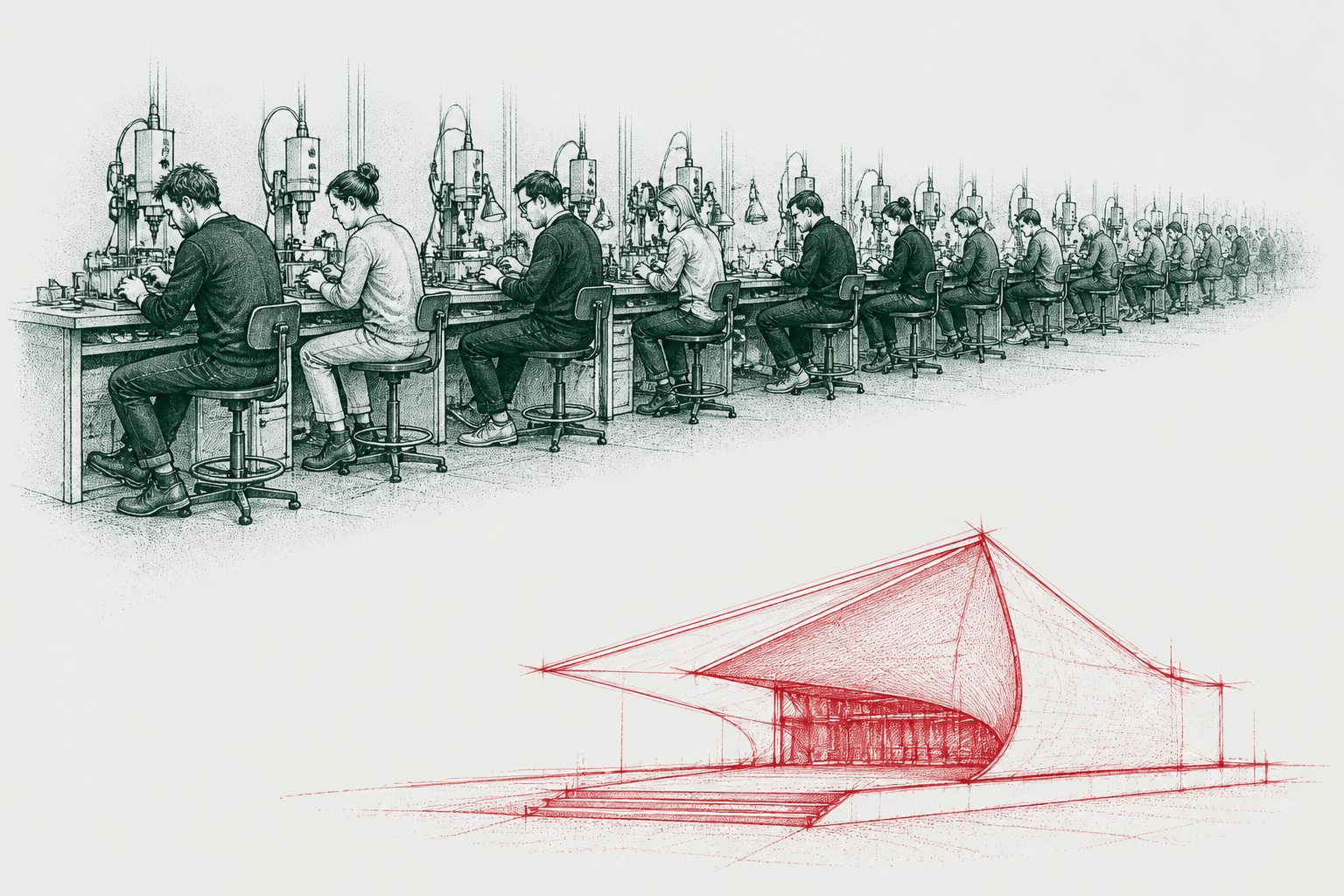
Most competitive strategy is an argument about position: cheaper, faster, better service, stronger relationships. It is a real argument and businesses win it every day. It is also exhausting, because every gain is a gain against people who are trying just as hard as you are.
Horizon Three asks a different question. Not how do we win this race, but what could we build that does not exist yet — something that creates its own category and, in doing so, makes direct comparison with competitors difficult or irrelevant.
Why the biggest build we ever did started as a small one
News Ltd did not commission a new category. They wanted better reporting.
What emerged from looking at the whole picture rather than the presenting problem was something else entirely: a single live model of a newspaper. Every page, every advertisement, every colour, every press configuration, held in one place and connected. When one of thirty salespeople sold an advertisement, the editorial space available, the press configuration and the financial forecast all adjusted in under a second.
That is not automation of an existing process. The knowledge of how a newspaper works had existed for decades — but it was distributed, each department holding its own piece, reconciled by meetings and experience. Making it one model created a capability that had not previously existed anywhere in the industry. Finance stopped looking two months backwards and started looking weeks forward. Sales could see availability across every title and edition without asking anyone.
Competitors without that platform were not just slower. They were structurally blind by comparison. That is the difference between winning a race and changing it.
Why the same principle works at a suburban scale
It would be easy to file Horizon Three under “things national publishers can afford”. Lilydale Books is the reason not to.
A family business supplying textbooks to schools, with decades of hard-won knowledge about how schools order, how teachers actually set booklists and what parents need at the start of a year. The first build was back-of-house: stock and orders, unglamorous and necessary. The second turned the same knowledge outward, into a portal parents used directly. The third made it possible to take on new schools without adding headcount for each one.
At no point did anyone declare a blue ocean strategy. They kept asking what the accumulated knowledge made possible next, and the answer eventually stopped being “a better version of what we do” and started being “something a generic wholesaler is not built to offer at all”.
One at the scale of a national publisher. One at the scale of a suburban bookshop. The principle is the same: organisations that build something genuinely different stop competing on the same terms as everyone else.
Why the uncomfortable question is the useful one
If a well-funded competitor decided to enter your market tomorrow — no history, no legacy systems, no obligations to the way things have always been done — what would they build?
Most leadership teams can answer this in about four minutes, and the answer is usually something they could build first. They have not, because the current model works, and everyone capable of building the new thing is busy running the old one. That is not a failure of imagination. It is what a functioning business feels like from the inside.
The companion question sharpens it further: what would need to be true for a much smaller team to do what you do? That is the leverage question, and its answer is usually the outline of a Horizon Three — because whatever makes a smaller team possible is also what makes direct comparison impossible.
Why this is not for everyone, and not for now
Horizon Three asks for more capital, more risk tolerance and more time before it returns. Pretending otherwise is how ambitious projects become cautionary tales, and how good businesses spend two years building something visionary while the operation that funds it quietly deteriorates.
The point of looking at all three horizons is not to pick the most exciting one. It is to make one specific decision better: given that you are going to build something in the next six months anyway, which starting point creates near-term value and opens the bigger door?
That is the connecting question, and it is where the framework earns its keep. Optima began as a reporting project. Lilydale began with stock control. Neither started at Horizon Three. Both were built by people who knew it was there.
Think big first. Build small second. In that order, every time.