Discovery asks what is wrong. An opportunity audit asks what could be.
The same knowledge, read three different ways: do what you do better, take it to people who can’t reach you today, or build something that doesn’t exist yet.
Only one of those makes you genuinely hard to replace — and only one of them is where almost everyone starts.
Why looking for problems only ever finds you better problems
Discovery is a conservative exercise by nature. You gather the team, map the pain points, list what’s broken and cost the fixes — and everything that comes out the other side is shaped by the question you asked. Solve every problem on the list and you have a tidier version of the business you already had.
That is not an argument against fixing things. It’s an argument about sequence. Before you decide what to build, it’s worth spending an hour on a different question entirely: not what is wrong here, but what could this become. The organisations that build genuine capability don’t just ask what needs fixing. They ask what’s possible.
Most businesses only ever play Horizon One.
It’s the closest horizon and the most legitimate one. It has the clearest business case, the shortest payback and the least argument in the room. It’s also the horizon your competitors are working on this quarter, with the same tools and the same consultants.
Getting faster at the same thing makes you more efficient. It does not make you harder to replace.
The three horizons are not a ladder you climb in order and they’re not three separate strategies. They’re three readings of one asset — the knowledge you already hold — and the point of looking at all three is that the answer to where do we start changes once you can see where you might end up.

Three horizons. One core IP.
Scale Up
Do what you do, better- Same customers, same market, less friction
- The test: what breaks if you grow by half tomorrow?
- Where the first return on investment usually lives
- Your competitors are working on this too
- Makes you more efficient, not harder to replace
Scale Out
Same knowledge, new customers- A new segment, a new market, a new delivery model
- Unlocks the IP stuck in spreadsheets and senior heads
- The test: who can’t reach you today, and why?
- Online, self-service, subscription, platform, white-label
- Reaches the market your current model cannot serve
Blue Ocean
Change the race- Build what doesn’t exist yet
- The test: what would a well-funded entrant build?
- Not better than competitors — a different category
- Needs more capital, more risk tolerance, more patience
- Where you stop being one of several reasonable options
Why Horizon One is the right place to start and the wrong place to stop
Scale Up is the honest answer to a simple question: how do you do what you already do, but better, more consistently and with less manual effort — and how do you handle more volume without adding proportional headcount?
The most useful version of that question has a number in it. What breaks if you grow fifty per cent tomorrow? Not gradually, not next year. Tomorrow. The answers arrive quickly and they’re specific: the person who’d be underwater, the spreadsheet that would stop reconciling, the process that only works because someone is watching it.
Fix those and you get real value — more jobs completed with the same team, service agreements held under pressure, error rates that stop climbing with volume. What you don’t get is distance from your competitors, because they’re fixing the same things.
 Essay
EssayThe Horizon You Can Already See
Scale Up is the horizon every business is already thinking about — which is exactly why it can’t be the whole plan. What it buys you, and where its ceiling sits.
Read → Essay
EssayThe Same Knowledge, a Different Customer
Horizon Two takes the expertise trapped in your senior people’s heads and puts it in front of people who could never reach it before.
Read →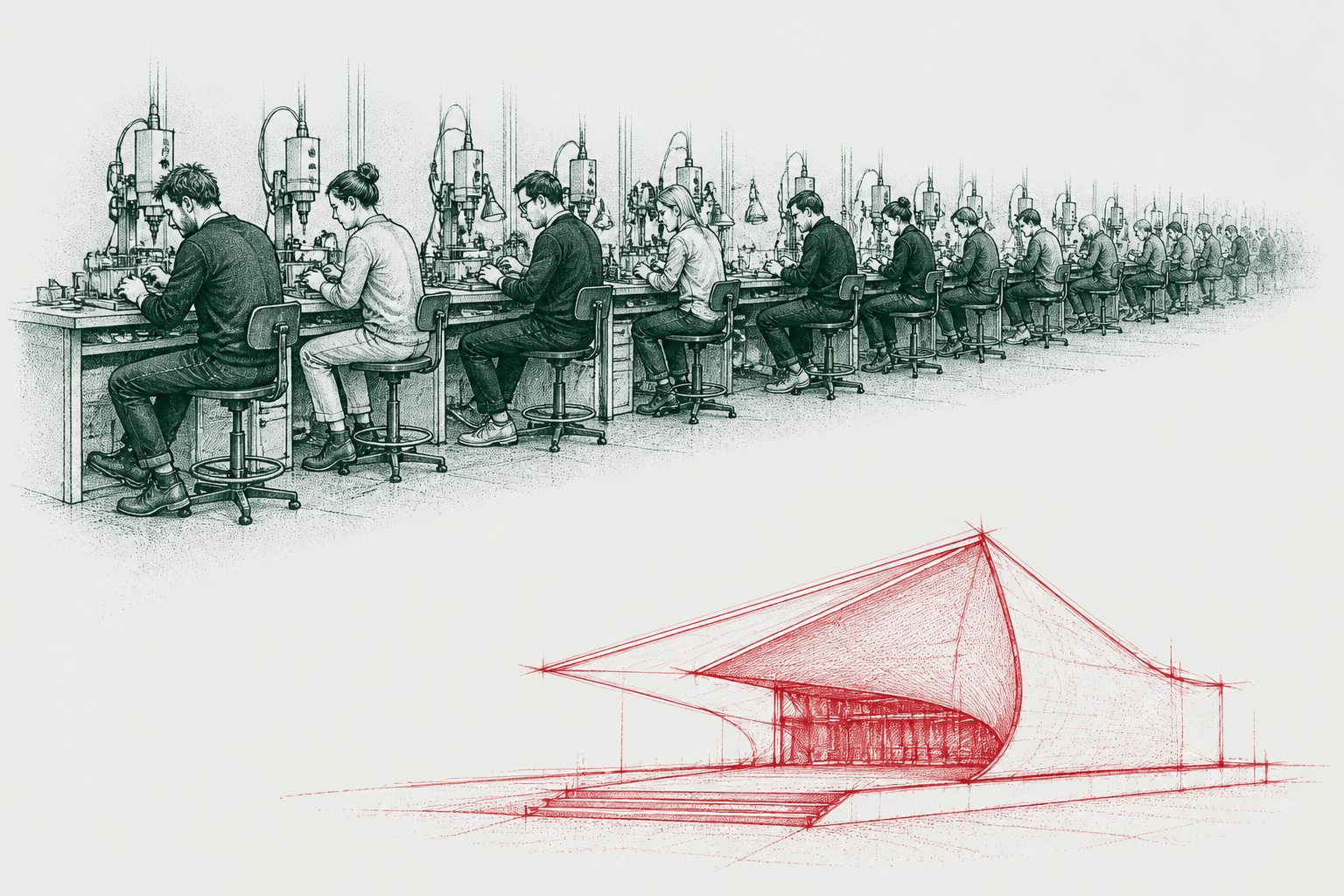 Essay
EssayChanging the Race
Horizon Three is where an organisation stops being one of several reasonable options and becomes genuinely hard to replace.
Read →
Why Horizon Two is usually the one hiding in plain sight
Scale Out means taking what you know and applying it somewhere new: a different customer segment, a different market, a different delivery model. Mechanically, it means taking the IP currently locked inside the organisation — the expertise living in spreadsheets and senior people’s heads — and finding a way to make it reachable at a scale the current model never could.
Tool World is the compact version of the whole idea. Ring quoting depended on two owners: they knew the metals, the tolerances and the pricing, and the business could only quote as fast as those two could sit down. Horizon One was making that judgement foolproof — an engine anyone in the office could run. Horizon Two was pointing the same engine at a different user entirely, so retail staff could quote for themselves in under two minutes without an owner in the loop. Same knowledge. New door.
The signals that a Horizon Two exists are ordinary and easy to miss. Somebody outside your usual customer group asks whether you’d do a smaller version. Clients keep asking for an adjacent service you don’t offer. A process that runs beautifully for twelve clients is obviously capable of running for two hundred, if only it didn’t need you in the room.
The Horizon Two question: who could benefit from what you know, but can’t reach you today — and what delivery model would change that? Online. Self-service. Subscription. Platform. White-label. First, find what you know: Hidden IP →
Why Horizon Three changes the race rather than your position in it
Blue Ocean asks what you could build that does not exist yet. Not a better version of your current service, and not an extension into an adjacent market. Something that creates its own category and, in doing so, makes direct comparison with your competitors difficult or irrelevant.
Optima is the example we come back to, because it started as a Horizon One project. News Ltd wanted faster reporting. What got built instead was a single live model of a newspaper — every page, advertisement, colour and press configuration in one place — where one sale by one of thirty salespeople adjusted editorial space, press configuration and the financial forecast in under a second. Competitors without that platform weren’t just slower. They were structurally blind by comparison.
The same principle runs at a suburban scale. Lilydale Books went from back-of-house stock management to a parent-facing portal that changed what a school supplier could be, and grew into schools that a generic wholesaler was never built to serve. One at the scale of a national publisher, one at the scale of a family bookshop, and the principle is identical: organisations that build something genuinely different stop competing on the same terms as everyone else.
Horizon Three is not where every organisation should be focused. It asks for more capital, more risk tolerance and more time before it returns, and pretending otherwise is how ambitious projects turn into cautionary tales.
The most useful question you can ask about your own business.
If a well-funded competitor decided to enter your market tomorrow, unencumbered by your history and your systems, what would they build?
This is an uncomfortable question. It’s also one of the most useful, because the honest answer is almost always something you could build first — you simply haven’t, because the current model works and the current model is what everyone is busy running.
The companion question is the one that turns insight into a plan: what would need to be true for a much smaller team to do what you do? That’s the leverage question, and the answer is usually the outline of a Horizon Three.

Why the horizon you are building for changes what you should build today
This is the practical payoff, and it’s the reason the audit comes before the roadmap. The horizon you’re aiming at changes the technology you choose, the architecture you build on, and the data you decide to capture in the very first phase.
Build purely for Horizon One and you optimise for today’s users and today’s volumes — reasonable, cheap, and frequently a dead end. Organisations that skip this step and build only for today often discover eighteen months later that what they built is a ceiling, not a foundation. The cost isn’t only the rebuild. It’s the confidence lost between the first promise and the second one.
How to map your own
Start from a picture of reality rather than memory — the actual flow of work, the actual customers, the actual constraints. Then walk the three sets of questions.
Horizon One. Where does volume create strain? What takes longer than it should? Where do errors cluster? What does the team wish it didn’t have to do by hand?
Horizon Two. Who else could benefit from what you know? What would a different delivery model make possible? What adjacent services do clients ask for that you don’t offer?
Horizon Three. What decision do your clients currently make badly for lack of information? What would need to be true for a much smaller team to do what you do? What would a well-funded competitor build? What would make direct comparison difficult or irrelevant?
Then the question that turns three lists into a plan: is there a Horizon One starting point that also lays the foundation for your Horizon Two or Three ambition? That’s the ideal entry point — near-term value that opens a bigger door. Think big first. Build small second. In that order, every time.
Run the Three Horizons Mapper → Then start small: Where to start → Book a conversation →