Case Study: Eat By Design Platform
Short form
The Eat By Design platform was built to solve two problems at once: give practitioners a tool that made personalised meal planning fast enough to be practical at scale, and give patients a daily connection to their practitioner’s guidance rather than a five-visits-per-year relationship. The drag-and-drop interface, recipe library, and ingredient ordering system changed the economics of nutritional care — less time per plan, more clients served, ongoing revenue from every grocery order.
The challenge
Delivering personalised meal plans by hand is slow. A practitioner working through a client’s conditions, preferences, household size, and weekly schedule — then assembling breakfast, lunch, dinner and snacks across seven days, making sure the shopping list matches — could spend more time on administration than on clinical work. Multiply that across a full client load and the maths doesn’t work.
Thea’s vision required the tool to be fast enough that personalisation was practical, not aspirational. If building a weekly plan for one client took an hour, practitioners would cut corners or limit the depth of what they prescribed. If it took ten minutes, they could do it properly for everyone.
The patient side had a parallel constraint. A meal plan delivered at a fortnightly appointment arrives at the wrong moment. By the time the patient is standing in a supermarket or looking at an empty fridge, the plan is somewhere in a folder. The guidance needed to be where the decision was being made — on a phone, visible at the moment someone was about to cook.
What we built
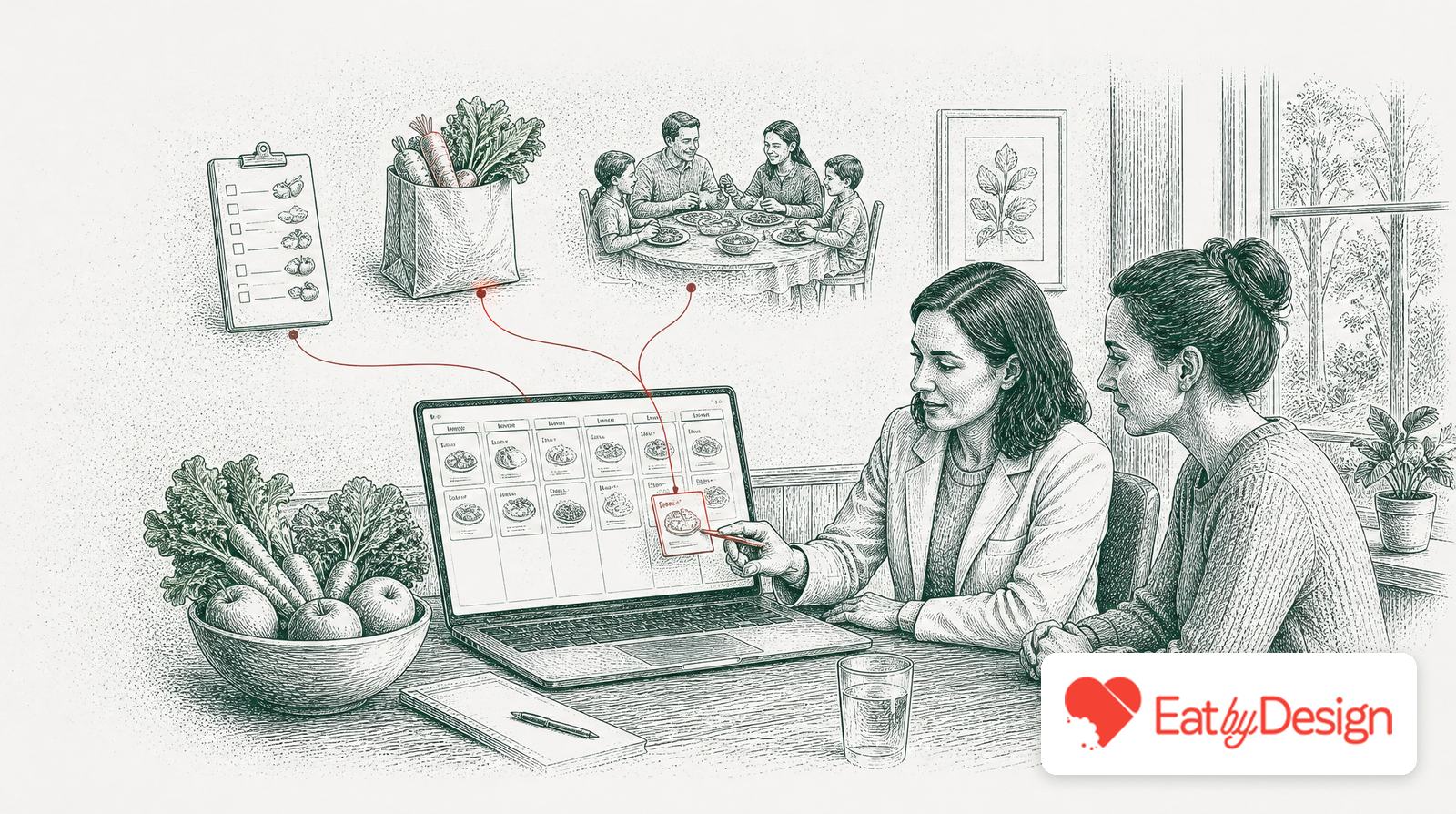
The practitioner interface was built around a weekly calendar view and a drag-and-drop recipe library. Practitioners set up each client’s profile — conditions, preferences, dietary restrictions, household makeup — and then assembled the week by dragging meals into place. The system handled the logic: checking that each day’s meals fit the client’s requirements, surfacing the right recipes from the library, and generating the complete shopping list automatically from whatever was on the plan.
The recipe library itself was designed to grow with the platform. Practitioners could use the built-in recipes or add their own, building a personal library over time. Favourite combinations could be saved and reused across clients with similar profiles. The repetitive work of building a plan from scratch each time was replaced by configuration — choosing from what already worked rather than starting from blank.
On the patient side, the app delivered the week’s plan in a format designed for the kitchen rather than the consulting room. Each recipe was visible on screen with full instructions. Ingredient ordering was built into the platform — patients could order what they needed for the week without switching apps or manually transcribing a list. Every order was tied to the plan their practitioner had built.
The feedback loop closed the gap between appointments. After each meal, patients could log how they felt, how easy the meal was to prepare, their energy levels, and any reactions. That data was visible to the practitioner between sessions — a continuous stream of information about how the plan was working in practice, not just in theory. Adjustments could be made without waiting for the next scheduled visit.
The business model was embedded in the ingredient ordering step. Practitioners took a revenue share on the grocery orders their clients placed through the platform. Every time a patient followed a plan and ordered the ingredients for it, the practitioner earned from that transaction. The revenue was ongoing and grew with client engagement rather than being capped by appointment slots.
The outcome
Practitioners who had been assembling plans manually found that the drag-and-drop tool brought planning time down to a fraction of what it had been. The ability to serve more clients at the same quality level, combined with ongoing revenue from ingredient orders, changed what a sustainable practice looked like.
Patients got a plan that met them where dietary decisions actually happened — in the supermarket, in the kitchen — rather than in a consulting room two weeks earlier. The feedback channel gave practitioners real data on adherence and reaction, making each successive plan more accurately tuned to how the patient was actually responding.
The ingredient order revenue stream was the first and most direct, but it was designed as the foundation rather than the ceiling. At scale, the platform had five or more identifiable revenue streams available to it: the practitioner subscription, the ingredient order clip, branded product lines, referral arrangements with health insurers, and data licensing to food manufacturers and researchers. Each required scale to activate, but the platform architecture was built with that progression in mind.
The platform delivered what Thea had set out to prove: that the right tool, built around the real shape of the problem, could change the economics of a profession that had been grinding against a broken model for years — and that a grocery chain investing in a nutritionist’s vision was not a strange outcome once the proof was in place.