The Same Knowledge, a Different Customer
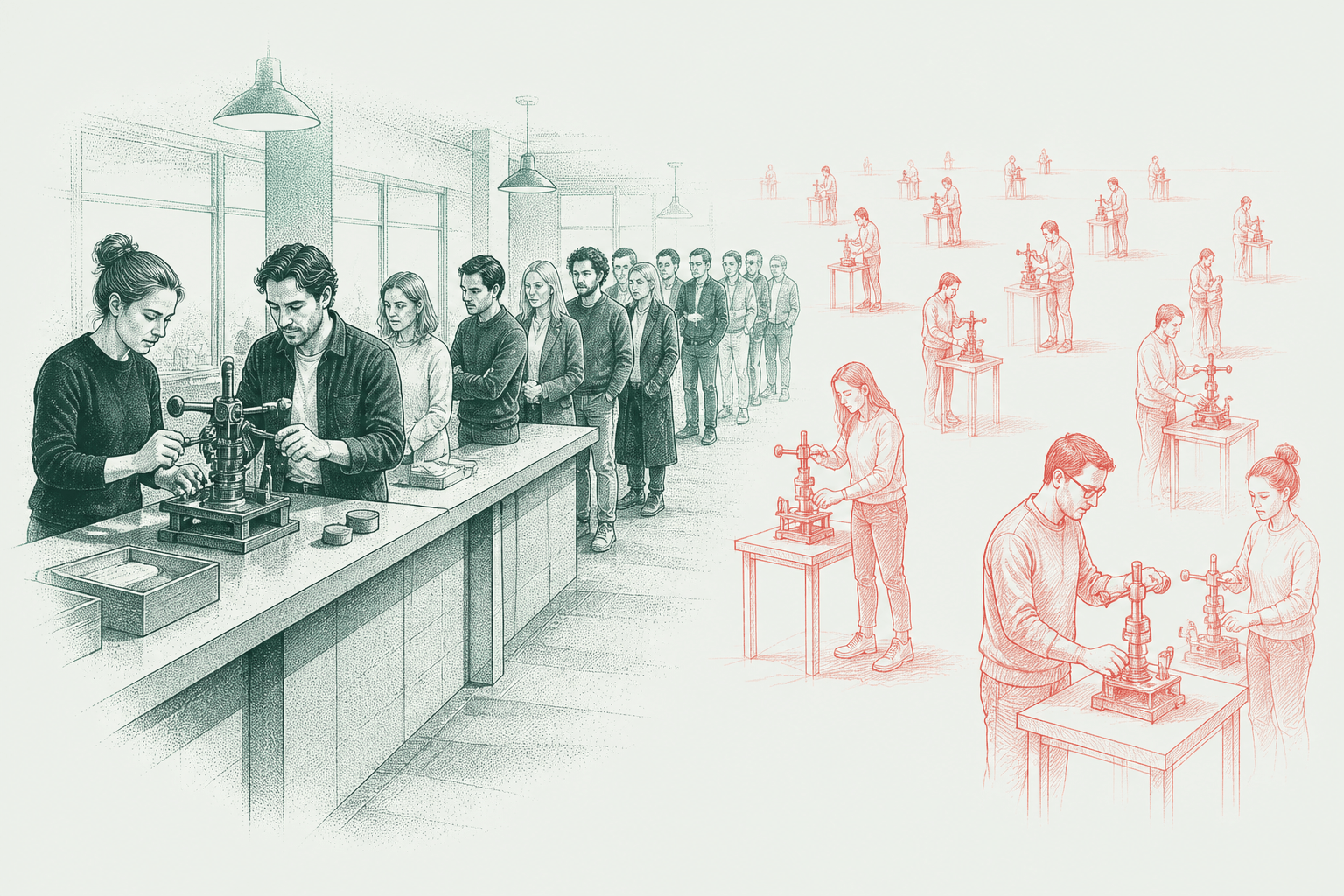
Every business has a ceiling made of people. Not because the people are the problem, but because the most valuable judgement in the company sits with a handful of them, and there are only so many afternoons in a week.
Horizon Two is what happens when you stop treating that as a fact of life. Scale Out means taking what you know and applying it somewhere new — a different customer segment, a different market, a different delivery model. Mechanically it means taking the IP currently locked inside the organisation and finding a way to make it reachable at a scale the current model never could.
Why the ceiling is usually two people’s calendars
Roberto came to Redgum because he spent his days writing quotes instead of working on the business. Tool World sells wholesale jewellery, and quoting a ring safely is real mathematics compounded by metal prices that move daily. Only the two owners could do it. A single quote took the better part of an hour, and every customer wanted several — to compare, to consider, to change their mind about the metal.
Look at that with Horizon One eyes and you see a productivity problem: make quoting faster. That reading is correct, and it was the right place to start. We built a quoting system that let anyone with less than an hour’s training quote and place an order safely. Key-person risk gone, owners’ afternoons returned.
Now look at the same asset with Horizon Two eyes. The quoting engine did not care who was operating it.
Why the same engine pointed at a new user is a different business
So we pointed it at Tool World’s customers. The engine became a portal that retail jewellers used themselves, with the orders flowing straight through to operations. A quote that used to consume an hour of an owner’s attention now takes under two minutes and needs no owner at all.
The interesting part is not the time saved. It is what became possible that had not previously existed. Every salesperson in every retail jewellery store could run through options with a customer standing in front of them, quote accurately on the spot, and order directly. Tool World stopped being a supplier you phoned and waited on, and became the fastest and easiest wholesaler in the trade to deal with — embedded in their customers’ own workflow, at the exact moment a sale was being made.
Quote volume rose sharply while staff effort fell. And the quoting data handed the owners something they had never had: a clear picture of which customers were actually worth the most to them. A quote used to be a bottleneck. It became a reason to choose Tool World.
Why the signals are ordinary enough to miss
Horizon Two opportunities do not announce themselves. They show up as slightly irritating questions.
Someone outside your usual customer group asks whether you would do a smaller version. Clients keep asking for an adjacent service you do not offer, and you keep saying no because it is not quite what you do. A process that runs beautifully for a dozen clients is obviously capable of running for two hundred, if only it did not need a senior person in the room each time.
The disciplined version of the question is worth writing down. Who could benefit from what you know but cannot reach you today, and what is actually in their way — price, geography, availability, or simply the fact that your knowledge is only available in the form of your time? Then: what would a different delivery model make possible? Online. Self-service. Subscription. Platform. White-label. Each of those is a different answer to the same constraint.
Why formalising has to come before scaling
There is an order to this and it is not negotiable. You cannot point an engine at new users until the engine exists, and the engine is what you get when tacit expertise has been made explicit — the metal prices, the tolerances, the rules of thumb, the exceptions that experienced people apply without noticing.
That is why Horizon Two so often begins as Horizon One work. The internal build is what forces the knowledge out of people’s heads and into a form that can be inspected, corrected and trusted. Tool World’s customer portal was only possible because the quoting logic had already been made foolproof for staff. The first project paid for itself. The second one changed the shape of the business.
Scale Out is not a new business. It is a new door onto the one you already have — and the reason so few organisations open it is that they never realised the room was full.