The most valuable thing in your business is the thing you have stopped noticing.
It isn’t on the balance sheet and it isn’t in the filing system. It’s in the spreadsheet everyone depends on, the judgement your longest-serving people make without thinking, and the workaround nobody ever documented.
You can’t build what competitors can’t copy until you’ve captured what makes you different.
Why you are the last person to see what you have
There is a consultant who plans retail catalogues. His spreadsheets weigh gross margin against stock position against how customers responded last cycle, and they answer in an afternoon a question that would take an analyst weeks of database work. Ask him what he does and he’ll tell you he plans catalogues. He thinks of the spreadsheets as his process — the way he happens to work.
They aren’t his process. They’re a productised methodology that he has never once described as a product. And that is the ordinary shape of hidden IP: not a secret, not a patent, just something so familiar to the people who own it that it has become background noise.
What you have already, in four shapes.
Formal IP — the things with paperwork. Usually the smallest category, and rarely the most valuable.
Know-how in someone’s head — the judgement calls, the rules of thumb, the reasons behind the reasons. Real, valuable, and entirely person-dependent.
Proven process — work that runs reliably on checklists, habits and a patchwork of apps, and that would be very hard for a stranger to reproduce.
Years of judgement buried in spreadsheets — the file that is critical to operations and terrifying to maintain, because only one person truly understands it. The Spreadsheet That Runs the Business makes the case that this file is not a risk to be tidied away but the clearest specification you will ever be handed.
Naming which is which is the whole first move. Creating Your Asset works through the taxonomy properly, and makes the case that your asset doesn’t begin with code — it begins with an honest, detailed description of the value you already deliver.

The distinction that matters: knowledge in someone’s head is a person-dependent liability. Knowledge that has been articulated, documented and built into a system is an organisational asset.
The franchise prototype test
The fastest way to find what you have is to imagine handing it to someone else. Forty-five minutes, two or three people who between them know the business well. Swipe through.
Why the gold hides in the places you stopped looking
Ask a room what should be automated and you get a list of annoyances. Ask what this organisation does that nobody outside it could do as well, and the room goes quiet — then someone starts talking about the thing they assumed everybody did.
Four hiding places account for most of it. Long-tenure heads. Critical spreadsheets. Informal processes that bear little resemblance to the documented ones. And decision patterns — the hundreds of recurring calls each week that rely on somebody’s experience rather than a written rule. The newest person in the room is often the most useful guide here, because they haven’t yet stopped seeing what everyone else has normalised.
The same knowledge, two states.
Trapped
A person-dependent liability- Lives in the heads of long-tenure staff, and leaves when they do
- Held in spreadsheets that are critical, brittle and undocumented
- Real workflows are informal adaptations nobody wrote down
- Hundreds of judgement calls a week, never explained
- Capacity is capped by how many hours your best people have
Formalised
An organisational asset- Captured in systems, tools, onboarding and quality control
- One live model everyone works from, showing the same current picture
- Your best thinking applied to every client at once, not just the ones the senior partner is on
- A new team member reaches competence in weeks, not years
- The business keeps working when the founder doesn’t
Not better filing. Not more thorough documentation. A fundamentally different competitive position.
Why capture is a thinking exercise, not a paperwork exercise
The instinct is to write documentation for other people. The more useful reason to write it is for yourself: you cannot systematise knowledge you have never articulated, and most businesses discover halfway through the first attempt that they don’t agree on how the work actually happens.
Two techniques do most of the heavy lifting. Map the workflow visually, following what the customer experiences rather than what the org chart implies. And write freely about the parts that resist mapping — the judgement, the exceptions, the “it depends” that turns out to depend on three things you can name once you try. Start where your understanding is deepest, usually the interaction with the user and what they receive, and work outward from there.
Structure is what makes knowledge portable.
Know-how doesn’t have to be patentable or technical to count. It has to be formalised — turned into something with a shape. A checklist. A scoring model. A process document. A course. A calculator.
The moment knowledge has a structure, someone else can apply it regardless of how much of their own experience they bring. That is the exact moment private know-how stops being something you carry and starts being something you own — and it is also the moment it becomes possible to sell it to more people than you could ever personally serve.
Empowering Experts follows that path to its commercial conclusion, and Lights, Camera, Transformation is the field guide to finding the raw material in everyday operations — because transformation is less about invention than recognition.
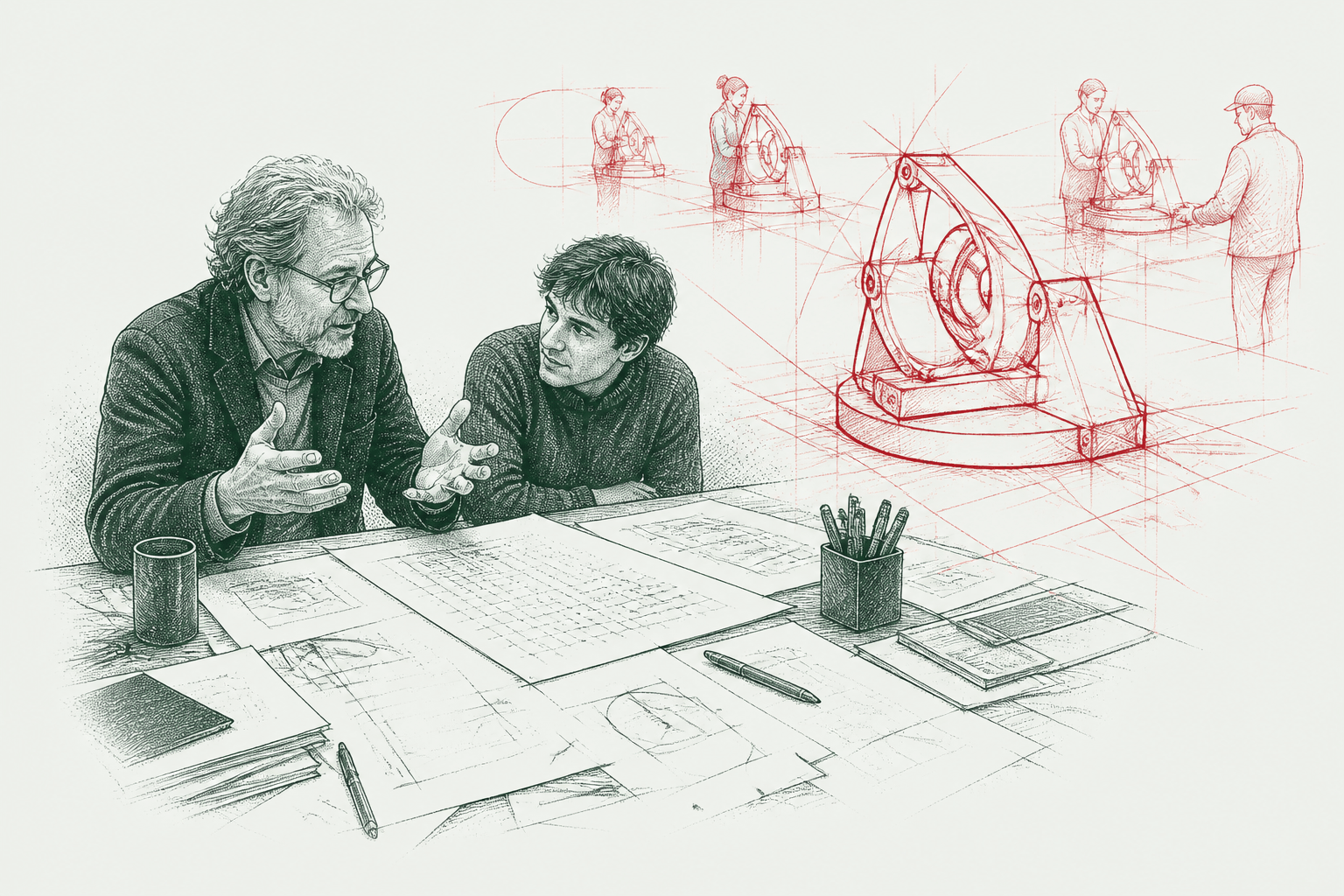
Why the finished form of captured knowledge is a live model, not a faster process
There’s a point where an organisation’s captured knowledge stops being documentation and becomes an operating asset: when there is one true view of the business that everyone works from, fed by what is actually happening rather than what was true last month.
News Ltd’s Optima is the clearest example we’ve built. The knowledge of how a newspaper works had existed for decades, but every department only held its own piece of it. Formalised into a single live model — every page, every advertisement, every colour and press configuration — one ad booking ripples through layout, press setup, editorial space and the financial forecast in under a second. Finance stopped looking back two months and started looking weeks forward. That isn’t automation of an existing process. It’s a capability that did not previously exist.
The same principle runs at suburban scale. Lilydale Books held deep knowledge about how schools order and what parents need; formalised, it became a back-of-house system, then a parent-facing portal, then the ability to take on new schools without adding headcount.
From know-how to asset, in two essays
What formalised knowledge makes commercially possible — and where to look for it first.
Essay
Empowering Experts to Commercialise Know-How into SaaS Platforms
Formalise what you know and it stops being something you carry and starts being something you own — reachable by people you could never personally serve.
Read →Essay
Embracing the Digital Twin
Give an organisation one true view of itself and better decisions follow — the operating form of knowledge you have finally written down.
Read →
What competitors cannot copy
A competitor can buy the same software you bought. They can hire from the same pool, read the same reports, and match your prices for as long as their balance sheet holds out. What they cannot do is buy the twenty years of judgement your business has accumulated — unless you leave it in a form that walks out the door with a resignation letter.
Formalising it is the first act of capability building because everything else stands on it. You cannot build what competitors can’t copy until you’ve captured what makes you different — the full argument, and what it does to your position over three years, is in What Competitors Can’t Copy.
The work is unglamorous, it takes a morning to start, and it is the highest-leverage hour most businesses never book.
Next: three ways to use what you have — The three horizons → Run the Hidden IP Audit → Book a conversation →