Everything you want to build, in the order it needs to be built.
Organise your full list of potential capabilities into a coherent, sequenced build plan that delivers value at every phase while building toward the larger ambition.
What it is
A capability roadmap is not a Gantt chart with fixed dates. It’s a picture of where you’re going and the sequence to get there, with room to adjust as you learn. The builder sorts everything you want to create into three layers: Foundational (core data, process and architecture that must exist first); Additive (features, users, integrations that extend what you can do, each valuable on its own); Transformational (the capabilities that change what the business fundamentally is, possible only once the first two layers are solid).
Why sequence matters
You can’t skip, not for process purity, but because the architecture doesn’t support it, the data isn’t there, and the organisation hasn’t built the muscle for a level-ten change while still absorbing level three. The tool makes dependencies visible so the sequence is chosen deliberately.
The living roadmap
A roadmap is only useful if it’s alive. The builder includes a review commitment: who owns it, how often it’s reviewed, and what triggers an unscheduled review, so it moves with the business without losing architectural coherence.
How to use it
After the Three Horizons Mapper and entry point. A senior internal person who can make (or influence) decisions. 90 minutes for a first pass; revisit quarterly. You’ll produce a layered, sequenced roadmap with defined releases and a review structure.
Work through it with Redgum
This one works best as a working session together, building on your answers from the free online tools. You walk away with a phased roadmap for the next 12 to 36 months, with a proof of value and budget range for every phase, so each one earns the next. Book a session → Start with the free online tools
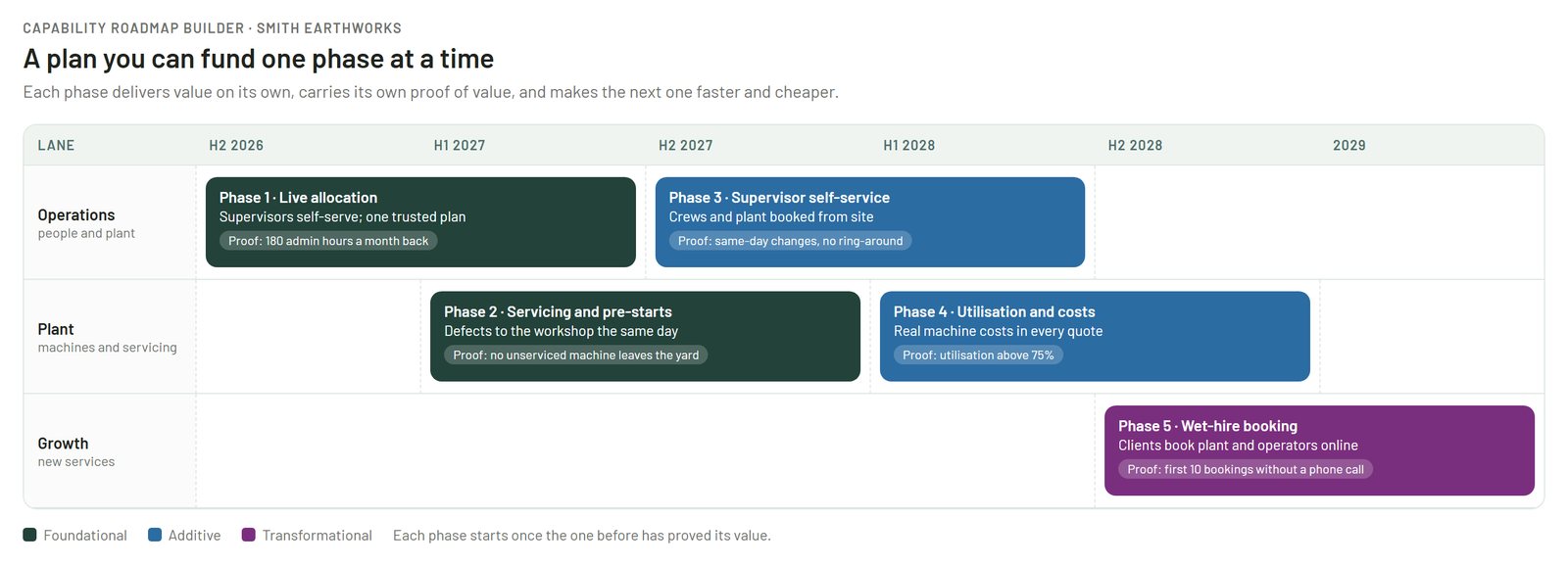
An example for a fictional business.
“The roadmap is not a promise about when things will be done. It’s a shared understanding of where the organisation is going and how it plans to get there.”
Building Capability, Ch 7