Case Study: Eat By Design
Short form
A grocery chain invested in a nutritionist’s vision. That’s not a typical origin story, but it’s what happened when Redgum helped Thea prove her idea first with meal boxes before pitching the platform. The proof worked, the chain came on board, and what followed was a technology platform that changed the economic model for an entire profession — turning five Medicare-funded visits a year into an ongoing relationship that practitioners could actually build a business around.
The challenge
Thea had seen two problems collide in the same industry for years, and she understood both from the inside.
The first was on the practitioner side. Nutritionists and dietitians spend years acquiring deep clinical knowledge, but not a single class in that training covers how to run a business. The economic structure they inherit when they graduate is punishing: Medicare funds five one-hour consultations per year per patient, and that is largely the revenue model. From that narrow window of contact, practitioners are expected to produce lasting change in eating behaviour shaped by a lifetime of habits, family dynamics, and personal circumstances. Many of the best-trained people in the field eventually leave it — not because they stop caring, but because the business doesn’t work and they can’t sustain it.
The second problem was on the patient side. Five hours of annual contact is not enough to change the way someone eats. Dietary behaviour is daily, contextual, and shaped by what’s in the fridge and what the family will accept. A fortnightly or monthly check-in with a practitioner reaches people at the wrong moments — between the decision to eat well and the actual meal. Without regular, low-friction support, adherence drops and outcomes disappoint. Patients feel they’ve failed. Practitioners feel they’ve failed. The system is set up to produce that outcome.
Thea’s insight was that these two problems had the same structural cause: a business model built on high-cost, low-frequency contact when what the patient needed was the opposite. The answer was to redesign the model, not the advice.
What we built
Redgum started by working through the business and revenue model with Thea before writing a line of code. The vision was right, but it needed to be proven in the market before a full platform could be justified.
The first step was meal boxes — curated, condition-specific meal kits designed for common dietary presentations: the kinds of meals a practitioner would prescribe for someone managing a chronic condition. The boxes were accessible, practical, and proved a simple point: people would buy them, use them, and come back. A grocery chain Redgum helped Thea approach saw the traction and the broader vision. They became an investment partner in what came next.
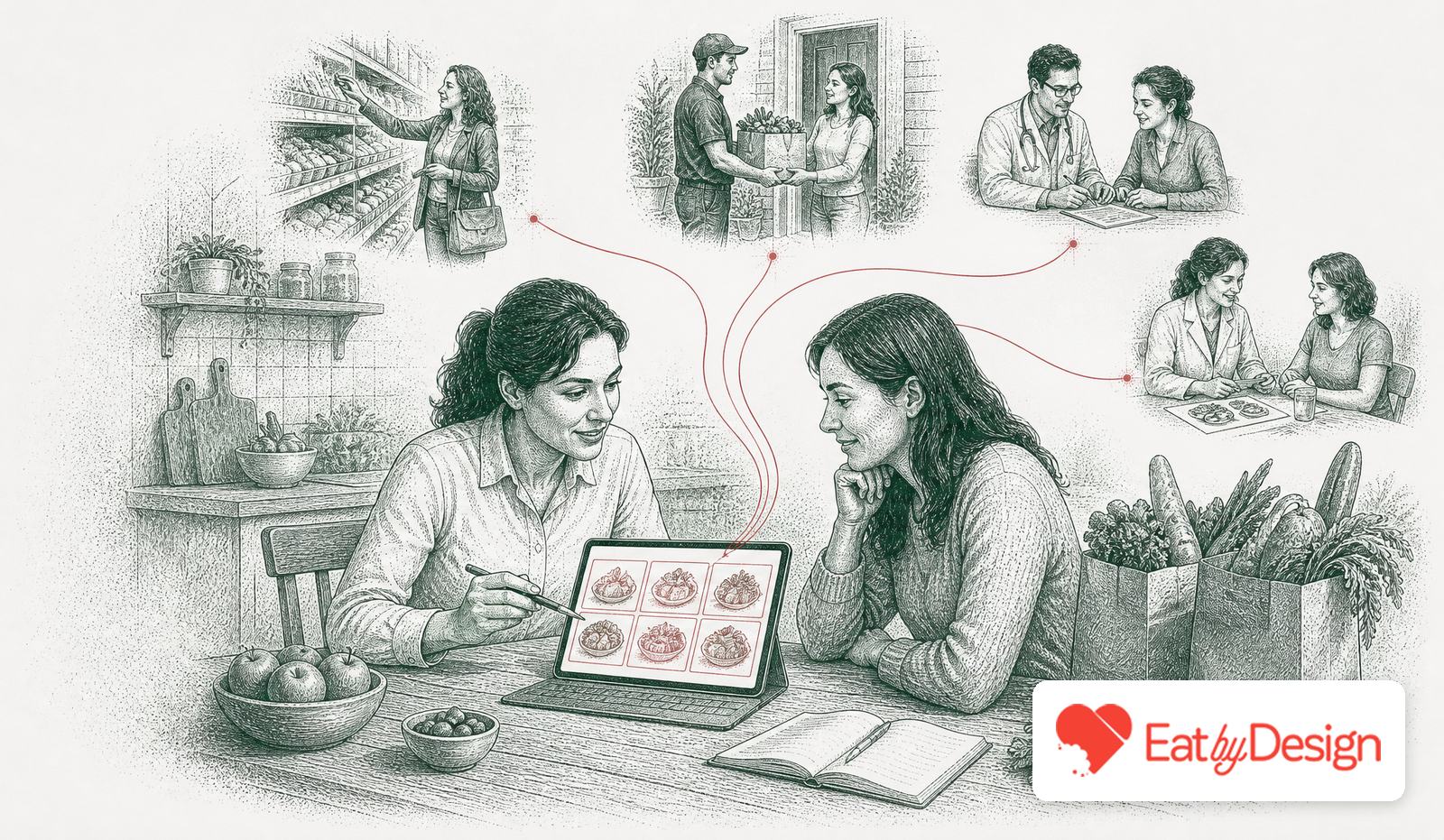
With that backing, Redgum designed and built the Eat By Design platform. At the practitioner end, the tool was built around the reality of how nutritionists work: a client profile, a weekly calendar view, and a drag-and-drop interface for assembling personalised meal plans from a growing recipe library. What might take hours of manual effort — matching meals to a client’s conditions, preferences, household size, and budget — became a matter of minutes. The plan was complete: every meal, every day, with the shopping list generated automatically from whatever the client needed to buy.
At the patient end, the experience was designed to reach people at the moment that actually mattered — when they were deciding what to cook. Patients could see each recipe on screen, order the ingredients they needed, and record how each meal went: how they felt, how easy it was to prepare, their energy levels, their reactions. That feedback flowed back to the practitioner, turning what had been a five-visits-per-year relationship into a continuous loop of data, adjustment, and support. The contact was cheaper, more frequent, and more useful than a clinical appointment.
The business model shifted accordingly. Instead of billing for time, practitioners subscribed to the platform and took a share of the ingredient orders their clients placed — a clip of the stream every time someone followed a plan. The revenue became ongoing rather than episodic, and it scaled with the number of clients a practitioner could maintain, not the number of hours they could work.
The outcome
The platform changed the economics of the profession. Practitioners who had been grinding through a model that couldn’t sustain them found a new revenue structure that grew with their client base rather than demanding more hours. Patients got regular, contextual support — a plan on their phone, a shopping list ready to use, a feedback channel to their practitioner between appointments.
The grocery chain’s investment reflected what the proof-of-concept had demonstrated: that people would change how they shopped and ate if the support structure made it easy enough. The platform made the practitioner’s expertise accessible at scale rather than rationing it to five hours a year.
What Thea set out to do was address a structural problem in her industry, not build an app. The technology was the mechanism. The outcome was a different kind of relationship between practitioners and their patients — one that could actually produce the results both parties wanted.
The platform did not reach the scale it was built for. COVID disrupted the market at a critical point in the growth trajectory, and the ambition of the vision — multiple revenue streams, a grocery chain partner, a profession-wide shift — required capital and runway that the timing did not allow. The project ran out of money before it could reach the inflection point where the economics tipped in its favour. That is a different kind of outcome than a technical failure or a wrong diagnosis of the problem. The problem was real, the solution worked, and the timing was wrong. Those are harder lessons than building something that doesn’t function.