Direction at the Top, Decisions at the Edge
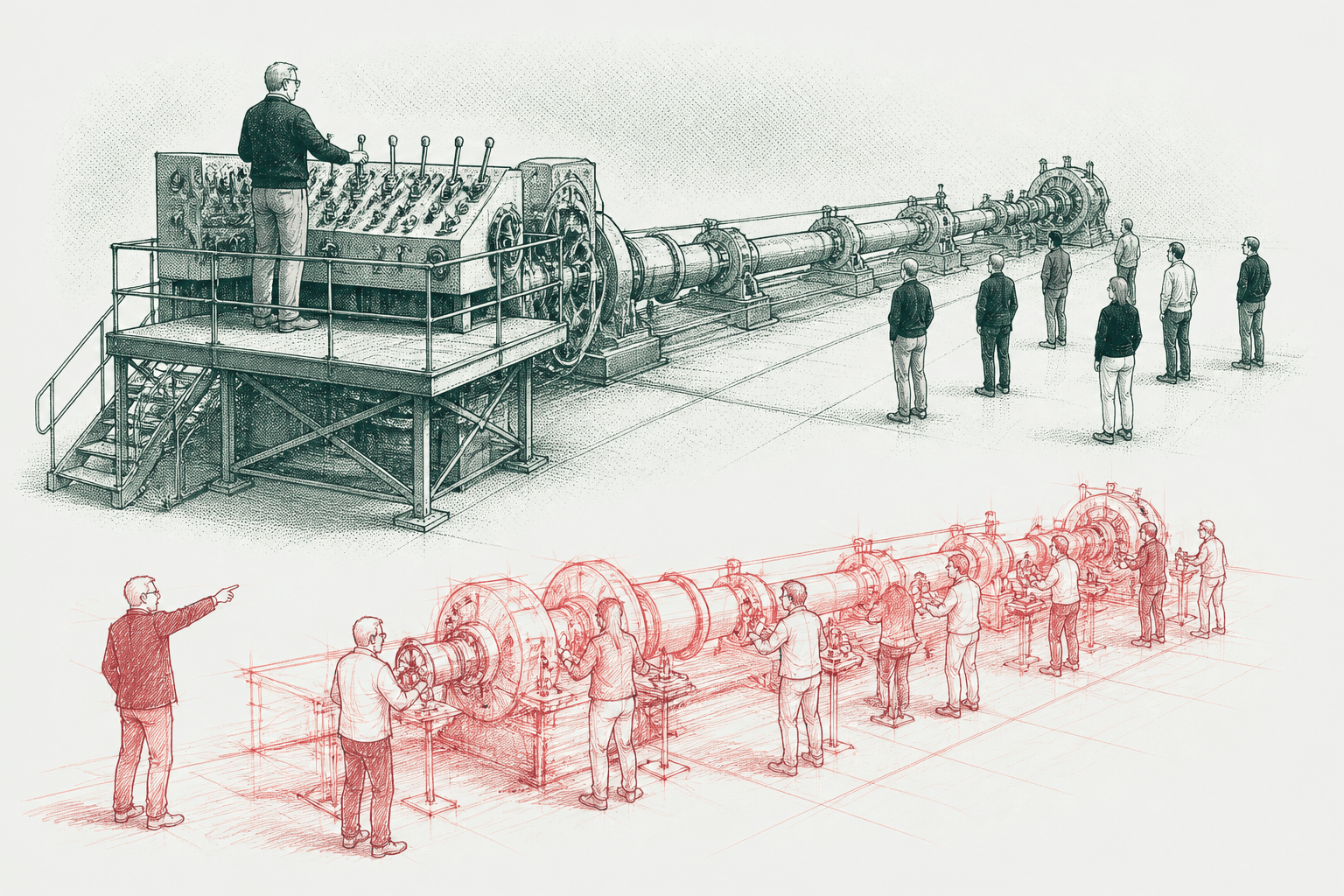
There is a particular kind of project failure that looks, from the top, like a success. The strategy was clear. The specification was thorough. Every decision was reviewed by someone senior enough to be accountable for it. And the thing that got built is subtly, persistently wrong in the places where the work actually happens.
This is the cost of confusing direction with control. Both feel like leadership. Only one of them scales.
Why the detail belongs with the people who live in it
A leader can describe an outcome precisely. What a leader almost never has is the texture — the fourteen exceptions, the reason step three has to happen before step two on Fridays, the customer type that breaks the rule, the thing everyone works around and nobody has mentioned because it stopped being remarkable years ago.
That knowledge sits with the people closest to the problem, and it does not survive being summarised upward. By the time it reaches a decision meeting it has become a bullet point, and the bullet point has lost the exact detail that would have changed the decision.
So the leaders who build capability that lasts do something that feels, initially, like letting go. They own the outcome and the guardrails — what we are trying to achieve, what we will not compromise, where the boundaries are — and they hand the nuance to the people who can see it. Vision, not supervision.
Why this raises standards rather than lowering them
The objection is reasonable: if I’m not deciding, how do I know it will be done properly?
The answer is that standards don’t live in approvals. They live in two places that survive delegation intact. The first is the guardrails themselves, stated once and clearly — the constraints that must hold whatever else changes. The second is testing done by the people who will actually use the thing, before it goes live, with the authority to say it isn’t right yet.
That second point is where most organisations quietly break their own quality system. User acceptance testing gets compressed, or handed to someone convenient rather than someone who does the job, because the real users are busy and the date is fixed. What’s left is a sign-off, not a test. And a sign-off tells you somebody agreed. A test tells you it works.
There’s a useful side effect, too. People who shaped a tool defend it. People handed a finished one audit it. Involvement isn’t a courtesy — it’s the cheapest adoption mechanism available, and it happens to produce a better product.
The signals that control has crept back in
Over-control is easy to diagnose if you know what to look for, because it shows up as latency rather than as an argument.
Decisions start waiting on a single calendar. Escalations rise — not because problems got harder, but because nobody below the escalation is sure they’re allowed to decide. The same questions come back repeatedly in slightly different forms. And user testing slips, again, because the users were never really trusted with it in the first place.
Any of those on its own is noise. Together they mean the organisation has stopped making decisions where the information is and started making them where the authority is, and the gap between those two places is where the cost lives.
Guardrails, not guard dogs
None of this is an argument for absent leadership. Direction is the harder half of the job, and it is not delegable: what we are for, what we will not do, what good looks like, what we are trying to be true a year from now.
But once that’s clear, the useful question stops being is this the decision I would have made? and becomes did the person closest to the problem have what they needed to make it well? If the answer is yes, the occasional decision you disagree with is a price worth paying — because the alternative is an organisation where every decision is yours, which is a description of a ceiling.
Trust is not a reward you hand out once the risk is gone. It’s a delivery strategy.